Showing posts with label Green Peafowl. Show all posts

Sunday, 17 April 2016

Green Peafowl filmed by camera trap in Puer, South Yunnan, China

With the situation looking rather grim in Yunnan (some experts fear extinction of Green Peafowl within the next 10 years), this article represents a glimmer of hope, and along with my previous post of Green Peafowl appearing in Puer in 2014 confirms they still persist in this area.


All photos here appear courtesy of the Puer Forestry Bureau.


Article and Videos:http://www.ccwb.cn/mobilenews/20160415174549XLYQMR.html
Here is a translation of an article posted on the Spring City Evening News in Yunnan:

"This year, we successfully filmed not only a wild Green Peafowl, but also displaying...", Pu'er City Forestry Bureau staff member Zhou Zhi-Tao told reporters of the Spring City Evening News on April. 15.  This may be the first recording of the courtship of the nationally-protected Green Peafowl, which is invaluable to the study of this species.

Zhou Zhi-Tao is the Division Deputy Chief of the Pu'Er Forestry Bureau's Wildlife Conservation and Nature Reserve department , and has dealt with wild animals and plants for many years. He said photographing Green Peafowl is far more difficult than Asian Elephants or Gibbons.

"We spent the 20 years finding and photographing Green Peafowl." Zhouzhi Tao said wild green peafowl in China found only in western Yunnan, central and southern. According to a 1991-1993 survey, the number of large Green Peafowl populations were in Jinggu, Mojiang, Ruili, Longchuan, Xinping, South China and other places, while in the past there have been local distribution records where they can no longer be seen.

"In early March this year, with our staff of the Pu'er City Forestry Bureau, at a distance for the first time to take the green peacock place about two kilometers of the place of the five cameras, camera to camera, the video is set to 30 seconds, half a month check. "Zhouzhi Tao introduction.

On March 28, a staff member checked the cameras, and found a roadside camera filmed a peacock of two meters in length.

"Compared with the peahen, peacock's tail is longer and more beautiful." pointing to the computer in the picture, Zhou Zhi-Tao said, a total of three photographs were taken of an adult male Green Peafowl. Compared with peacock blue peacock green, the most obvious difference is the neck feathers, green peacock body feathers turquoise green and blue peacock blue even more. In addition, the Yunnan local green peacock bird, blue peacock Southeast Asia introduced exotic birds.

Thereafter was another new discovery. From a camera mounted at the hilltop, a Green Peafowl was filmed


From April 1, two separate were filmed at 9:08 and 9:53, in which the first video, a displaying Green Peacock appears on the right side of the screen, rotating in place nearly 360 degrees, called a sound similar to a cat; in the second video, the peacock repeatedly raised its head to look at its surroundings.


At 10:06 on April 5 and 10:08, a male Green Peafowl was filmed twice, when it was foraging.


Zhou speculated that the four video shot in April show the same bird, but it is difficult to determine if it is the same bird filmed earlier on the roadside, as the distance between the two sites is 500 meters. From the current investigations and image data analysis, Pu'er wild green peacocks exist. "Green Peacock photographed this area, workers have seen five individuals fly to a ditch to drink; through call analysis, there should be over ten individuals." Green Peacock usually start their courtship period from March to May, after which eggs are laid, until September to October, young are hatched and raised by the mother, villagers will see often see Green Peafowl in these two periods.

According to data gathered during this visit, the Green Peafowl of Pu'Er live at an elevation of 1000 to 1800 m, mainly in tropical and subtropical evergreen broadleaf and mixed forests, especially like in the savanna, jungle and river banks, or open areas on the edge of the forest where they are active in the morning and afternoon. They like to eat peas, rice and some small insects.

"In addition to the confirmed presence of Green Peafowl photographed in Jinggu, we will examine Jingdong, Zhenyuan, and Mojiang where there is a high probability that wild Green Peafowl are present." Zhou said that for the further directions, in addition to protection and increased awareness of the Green Peafowl, they also will carry out further studies to understand more about the biology of the Green Peafowl.


Additional Notes (these reflect my own views and not those of the article itself)
An adult male Green Peafowl was filmed in Pu'Er in April 2016. Unlike the darker necked form that inhabits Northwest Yunnan which superficially resembles spicifer (and has sometimes been described as a distinct species, Pavo antiqus) and lives in a tropical conifer habitat, these birds more closely resemble the imperator Green Peafowl of North Thailand but unlike these they inhabit a broadleaf mixed forest above 1000m. This morphotype has sometimes been known as Pavo muticus annamensis but is currently universally recognized as Pavo muticus imperator as with the North Yunnan form and other Green Peafowl of Thailand, Cambodia, Laos and Vietnam.  In some Chinese articles, they mention in passing that imperator of Yunnan has some subtle differences. In my opinion this classification requires significant revision and further research into the various populations. I will be covering this issue in greater detail later on but for now let us enjoy these wonderful images


Tuesday, 24 June 2014

Recent news from Yunnan

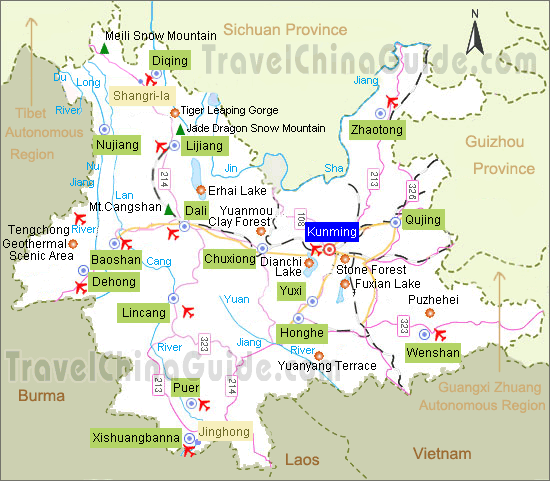
 At the start of the 20th century, Green Peafowl were widespread through the province and its neighbouring provinces, but is now restricted to small fragmented areas such as Dali, Shuangbai Konglonghe. Xishuangbanna in Southern Yunnan was once famous for Peafowl, but sadly wild Green Peafowl have become extinct and feral Indian Peafowl and hybrids roam some areas. The problem of hybridization is often overlooked as people fail to differentiate between Green and Indian Peafowl, partly because in Chinese both species' common name describes their colours (Green and Blue Peafowl), but the female Indian Peafowl has a green neck. They are rarely photographed in the wild because they are rare and found in more remote areas.

A map of Yunnan.
Source: TravelChinaGuide.com
Over the last week, Green Peafowl have made headlines in China. In a recent article, some experts expressed fear that the Green Peafowl will become extinct in Yunnan within the next 10 years, citing a significant decrease in records within the past hundred years.


There is however, some hope. In April 2014, a group of researchers filmed wild Green Peafowl in Pu'Er, Southern Yunnan.  Green Peafowl had been reported by locals before, but it took 20 years for the Forestry Bureau to confirm their presence here. Although it appears only one male was filmed by the infrared camera traps, Zhou Zhi Tao of the Pu'Er city Wildlife Conservation and Reserve Management head estimated there to be 10 to 15 individuals here. Locals have heard their calls and have also reported seeing a family of Green Peafowl with three chicks.

A Green Peafowl caught by camera-trap in Pu'Er, Yunnan, China
Take a note the broadleaf-evergreen forest this bird inhabits.
Source: Pu'Er Forestry Bureau

The following is an article from CCTV:
A wild green peafowl was captured on camera foraging in the city of Pu'er, southwest China's Yunnan Province, in April, according to the city's Forestry Bureau.

This is China's first ever video footage of wild green peafowl, according to Zhou Zhitao, head of the department managing wildlife protection and nature reserve under Pu'er Forestry Bureau.

"There are wild green peafowls in China, but it is the first time that we have gotten video footage of it in Pu'er. It is also China's first video footage of the species," said Zhou.

The bureau decided to step up monitoring and protection of the species, which had disappeared in the wild for almost 20 years.

"The camera footage of the green peafowl is a breakthrough for the study of the species. At least we know that out there the green peafowl does exist. The footage will provide information for how to protect and monitor the species, establish protection zone, and restore habitats," said Zhou Zhitao.

The green peafowl has been listed among the animals under the first-class state protection in China.
Watch the video here: newscontent.cctv.com/NewJsp/news.jsp?fileId=245495

Another news report with the same footage: http://v.yntv.cn/content/117/201406/16/117_921377.shtml

Sidenote

The Xishuangbanna annamensis morphotype.
Under the current classification, all Green Peafowl are classified as Pavo muticus imperator, but following a proposed revision in classification the Southern Yunnan form has been described as the (sub)species "Pavo (muticus) annamensis." This is by no means a definite classification as research is ongoing, but these birds of Southern Yunnan, and similar birds in Cambodia's Cardamom Mountains, Lao's Bolaven Plateau and Vietnam's Annamite Range, appear to inhabit broadleaf evergreen forests at an altitude of about 2000 feet. These recent images only seem to confirm this.

In the montane forests of Northwestern Yunnan lives another type of Green Peafowl, even more distinct. Known around some circles as Pavo antiqus, it is the largest living Peafowl species and may be a direct descendant of the Pliocene fossil species Pavo bravardi. Elusive in the wild, a small population has been filmed in Qinghua, Weishan, Dali prefecture in the past few years, including an unusual peahen with white feathers on her wings.  This morphotype is maintained by some breeding stations, notably at the Kunming Zoo, but it is difficult to establish the origins of captive birds; some may be hybrids.

A Chinese study on the divergence between Green Peafowl and Indian Peafowl also seems to support there are multiple distinct forms of Green Peafowl in Yunnan. The Kunming Zoological Institute has been extensively studying Green Peafowl and their conservation, but much of the research with respect to systematics has not been published.

This is something I will discuss later, but below is a photograph of this Northwestern Yunnan Peafowl.

This photograph was taken in Wanding, Yunnan, bordering Burma, in 2012. This is an enigmatic morphotype of the Northwest is sometimes described as Pavo antiqus, but has not yet been formally been described.

The Future

The future is uneasy for Green Peafowl in Yunnan. Unlike Thailand and Vietnam, where populations are rather secure and protected (and extensively photographed), a lot more work needs to be done in China to validate the presence of Green Peafowl in various areas of Yunnan. Another problem is that although they are protected by law, people fail to differentiate between Green and Indian Peafowl, leading to feral Indian Peafowl and hybrids being released in some areas.

Here are several conservation measures that I propose:
1. Educate the locals to avoid conflicts with the Green Peafowl.
2. Educate the public so that they can distinguish between Green Peafowl and Indian Peafowl as well as hybrids.
3. Enforce stricter wildlife laws to regulate the trade of domestic Indian Peafowl and prevent their release in areas with Green Peafowl.
4. DNA testing of Peafowl of unknown origins to determine whether they are hybrids. Hybrids should not be put to waste but rather bred to a similar hybrid, to establish an "heirloom stock".
5. Establish whether various populations of Green Peafowl in Yunnan belong to different (sub)species. If multiple forms can be identified, they should be split to increase their conservation.
6. Following this classification, establish a studbook for captive birds.

I hope the recent news from Yunnan will spark public awareness of these fascinating creatures, and encourage conservationists and researchers to continue with their efforts.

Sources:

  1. CCTV, "Critically endangered wild green peafowl filmed in SW China forest"
  2. News Report from YNTV
  3. Report from Yunnan.cn: http://yn.yunnan.cn/html/2014-06/20/content_3254637.htm
  4.  Ouyang, Yi Na (2008). "Genetic Divergence between Pavo muticus and Pavo cristatus by Cyt b Gene". Journal of Yunnan Agricultural University.