Tuesday, 24 June 2014

Recent news from Yunnan

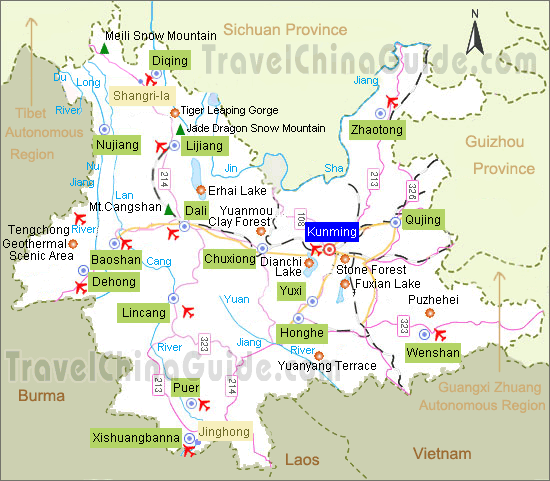
 At the start of the 20th century, Green Peafowl were widespread through the province and its neighbouring provinces, but is now restricted to small fragmented areas such as Dali, Shuangbai Konglonghe. Xishuangbanna in Southern Yunnan was once famous for Peafowl, but sadly wild Green Peafowl have become extinct and feral Indian Peafowl and hybrids roam some areas. The problem of hybridization is often overlooked as people fail to differentiate between Green and Indian Peafowl, partly because in Chinese both species' common name describes their colours (Green and Blue Peafowl), but the female Indian Peafowl has a green neck. They are rarely photographed in the wild because they are rare and found in more remote areas.

A map of Yunnan.
Source: TravelChinaGuide.com
Over the last week, Green Peafowl have made headlines in China. In a recent article, some experts expressed fear that the Green Peafowl will become extinct in Yunnan within the next 10 years, citing a significant decrease in records within the past hundred years.


There is however, some hope. In April 2014, a group of researchers filmed wild Green Peafowl in Pu'Er, Southern Yunnan.  Green Peafowl had been reported by locals before, but it took 20 years for the Forestry Bureau to confirm their presence here. Although it appears only one male was filmed by the infrared camera traps, Zhou Zhi Tao of the Pu'Er city Wildlife Conservation and Reserve Management head estimated there to be 10 to 15 individuals here. Locals have heard their calls and have also reported seeing a family of Green Peafowl with three chicks.

A Green Peafowl caught by camera-trap in Pu'Er, Yunnan, China
Take a note the broadleaf-evergreen forest this bird inhabits.
Source: Pu'Er Forestry Bureau

The following is an article from CCTV:
A wild green peafowl was captured on camera foraging in the city of Pu'er, southwest China's Yunnan Province, in April, according to the city's Forestry Bureau.

This is China's first ever video footage of wild green peafowl, according to Zhou Zhitao, head of the department managing wildlife protection and nature reserve under Pu'er Forestry Bureau.

"There are wild green peafowls in China, but it is the first time that we have gotten video footage of it in Pu'er. It is also China's first video footage of the species," said Zhou.

The bureau decided to step up monitoring and protection of the species, which had disappeared in the wild for almost 20 years.

"The camera footage of the green peafowl is a breakthrough for the study of the species. At least we know that out there the green peafowl does exist. The footage will provide information for how to protect and monitor the species, establish protection zone, and restore habitats," said Zhou Zhitao.

The green peafowl has been listed among the animals under the first-class state protection in China.
Watch the video here: newscontent.cctv.com/NewJsp/news.jsp?fileId=245495

Another news report with the same footage: http://v.yntv.cn/content/117/201406/16/117_921377.shtml

Sidenote

The Xishuangbanna annamensis morphotype.
Under the current classification, all Green Peafowl are classified as Pavo muticus imperator, but following a proposed revision in classification the Southern Yunnan form has been described as the (sub)species "Pavo (muticus) annamensis." This is by no means a definite classification as research is ongoing, but these birds of Southern Yunnan, and similar birds in Cambodia's Cardamom Mountains, Lao's Bolaven Plateau and Vietnam's Annamite Range, appear to inhabit broadleaf evergreen forests at an altitude of about 2000 feet. These recent images only seem to confirm this.

In the montane forests of Northwestern Yunnan lives another type of Green Peafowl, even more distinct. Known around some circles as Pavo antiqus, it is the largest living Peafowl species and may be a direct descendant of the Pliocene fossil species Pavo bravardi. Elusive in the wild, a small population has been filmed in Qinghua, Weishan, Dali prefecture in the past few years, including an unusual peahen with white feathers on her wings.  This morphotype is maintained by some breeding stations, notably at the Kunming Zoo, but it is difficult to establish the origins of captive birds; some may be hybrids.

A Chinese study on the divergence between Green Peafowl and Indian Peafowl also seems to support there are multiple distinct forms of Green Peafowl in Yunnan. The Kunming Zoological Institute has been extensively studying Green Peafowl and their conservation, but much of the research with respect to systematics has not been published.

This is something I will discuss later, but below is a photograph of this Northwestern Yunnan Peafowl.

This photograph was taken in Wanding, Yunnan, bordering Burma, in 2012. This is an enigmatic morphotype of the Northwest is sometimes described as Pavo antiqus, but has not yet been formally been described.

The Future

The future is uneasy for Green Peafowl in Yunnan. Unlike Thailand and Vietnam, where populations are rather secure and protected (and extensively photographed), a lot more work needs to be done in China to validate the presence of Green Peafowl in various areas of Yunnan. Another problem is that although they are protected by law, people fail to differentiate between Green and Indian Peafowl, leading to feral Indian Peafowl and hybrids being released in some areas.

Here are several conservation measures that I propose:
1. Educate the locals to avoid conflicts with the Green Peafowl.
2. Educate the public so that they can distinguish between Green Peafowl and Indian Peafowl as well as hybrids.
3. Enforce stricter wildlife laws to regulate the trade of domestic Indian Peafowl and prevent their release in areas with Green Peafowl.
4. DNA testing of Peafowl of unknown origins to determine whether they are hybrids. Hybrids should not be put to waste but rather bred to a similar hybrid, to establish an "heirloom stock".
5. Establish whether various populations of Green Peafowl in Yunnan belong to different (sub)species. If multiple forms can be identified, they should be split to increase their conservation.
6. Following this classification, establish a studbook for captive birds.

I hope the recent news from Yunnan will spark public awareness of these fascinating creatures, and encourage conservationists and researchers to continue with their efforts.

Sources:

  1. CCTV, "Critically endangered wild green peafowl filmed in SW China forest"
  2. News Report from YNTV
  3. Report from Yunnan.cn: http://yn.yunnan.cn/html/2014-06/20/content_3254637.htm
  4.  Ouyang, Yi Na (2008). "Genetic Divergence between Pavo muticus and Pavo cristatus by Cyt b Gene". Journal of Yunnan Agricultural University.

Saturday, 21 December 2013

Analogies

We have a tendency to think of Peafowl as nothing more than a bird where the males advertise themselves to attract females. Much is focused on the breeding behaviours and less so on ecology and other kinds of behaviour. I think many of the conceptions we have about Peafowl displays are wrong. I will address this a bit later, but first it is important to understand the niche of the Green Peafowl. We must focus on other long-legged birds around the world to gain a better understanding of peafowl.

Secretarybird
Photo by Yoky from Wikipedia

The Secretarybird is found in sub-Saharan Africa. It is a nomadic species and can be found in different elevations ranging from the coastal plains to the highlands. Its preferred habitat consists of grasslands or savannah. Secretarybirds spend much of the day on the ground but roost on Acacia trees. The Secretarybird is monogamous and associates in pairs.

Compared to Green Peafowl and other birds in this post, Secretarybirds are strictly carnivorous. Famous for snake hunting, it discovers prey by stomping on vegetation. They either stomp on their prey or they can chase them and strike them with their bill. Their diet also consists of insects and vertebrates of various sizes.

Seriema

Red-Legged Seriema at the National Zoo, photograph by Frank Lin

The Red-Legged Seriema is a South American counterpart to the Secretarybird. They are unrelated but share similar traits due to convergent evolution. They too feed on snakes and other small animals, but also occasionally on plants. When they take reptiles they beat their prey onto the ground, or throw it at a hard surface. They will also rip larger prey into pieces with their claws. The Seriema prefer to walk instead of flying because their wings are short.

Like Secretarybirds and some Green Peafowl, the Seriema prefers a grassland habitat. Its distinctive call can carry for kilometers. It likes meadows near rivers but tries to avoid wetlands and crop fields. (Green Peafowl, on the other hand, are sometimes considered a crop pest and unfortunately some farmers will poison them)

Blue Crane
Blue Crane at the National Zoo, photograph by Frank Lin
An elegant species, the Blue Crane is the national bird of South Africa, and there is a lot more than meets the eye.  Unlike some cranes, Blue Cranes rarely feed by wetlands and are a more grassland species. Blue Cranes mostly on grasses and sedges, as well as insects. They may also occasionally take on small vertebrates. Blue Cranes are somewhat social, less so during the breeding season. They have a strict hierarchy with dominant males at the top. Cranes of all ages engage in dancing, not just for courtship.

Tuesday, 26 November 2013

What is a Peafowl?

We often have the image of peafowl, more specifically peacocks, the males, as birds that show off their feathers to attract potential mates. However, there is more than meets the eye when it comes to peafowl.

First of all, what is a peafowl? They are traditionally classified in the order Galliformes and traditionally considered part of the pheasant family. However, there have been some studies that show Phasianidae is paraphyletic. In my opinion, peafowl should not be classified as part of Phasianidae.

There are three species classified as Peafowl - the Indian or Blue Peafowl (Pavo cristatus), the Green Peafowl (Pavo muticus) and the Congo Peafowl (Afropavo congensis).The Indian Peafowl is one of the world's most well-known bird species. The Green Peafowl, and its many subspecies (or species) will be the key focus of this blog. The Congo Peafowl is an enigma that was only discovered in 1936 and seems to be a more primitive species than the Green and Indian Peafowls. The Argus Pheasants (Argusianus and Rheinartia) are not true pheasants, but are also primitive forms of Peafowl.

Which brings us back to the Green Peafowl. Known as the Dragonbird or Snake Dancer in its native haunts, it is the largest galliform in overall length and wingspan, it distinguishes itself from its Indian cousin by its shafted crest, coloured facial skin, and iridescent green neck. Its secondary wing feathers are black with scapular feathers that are blue.

There are traditionally believed to be three subspecies of Green Peafowl:
*The nominate subspecies, Pavo muticus muticus is currently endemic to the East and West ends of the Island of Java. It was also believed to be found in Malaysia and Southern Thailand though there is some indication the Java and Malay forms were distinct. muticus is often referred to as the Java Peafowl, but this name has unfortunately been used to describe all Green Peafowl, which should be avoided. muticus is typically described as the "brightest" or most "colourful" of the three subspecies, which has led to its demise in Malaysia and Southern Thailand.
*P. m. spicifer is the westernmost subspecies, found mainly in Burma, often referred to as the Burmese Peafowl. It was also once found in Northeast India and Bangladesh, and captive birds of this morphotype are also found in Thailand and Malaysia, but its status in these countries is unknown. Sadly, it has sometimes been described as the "dullest" of the three subspecies. This is a subjective description and has sadly led it to be rather rare compared to the other two subspecies. Few breeders seem to fancy this form and its status in the wild is currently unknown, although it is known to occur in Northern Burma and has been reintroduced in the Southern Burma. Its neck is a matte green to gun-metal blue hue, while its wings are darker than the other subspecies. spicifer tends to be a larger bird than the other two subspecies, with a taller stance. It is also distinctive in that the bluish feathers of the crown and head extend more far behind the head than the other two subspecies of Green Peafowl, forming a distinctive demarcation line.
*P. m. imperator, the Indo-Chinese Peafowl, is the most widely distributed of the three subspecies, found from eastern Burma east towards Southern Vietnam. The Green Peafowl of Yunnan are also described as imperator. Thailand, Vietnam and Cambodia are home to its last strongholds. Often it is described as intermediate between the other two forms, not quite as brilliantly coloured as muticus but more brilliant that spicifer. This is no longer an accurate description. The facial skin is very dark and intense, a bold orange and blue. Finally, the tertial feathers of the hind wing are often extensively barred.

We will be looking at the classification of these three forms a bit later.

Welcome!

Welcome to The Dragonbird's Lair.

This blog is dedicated to bringing the awareness of the spectacular bird known as Green Peafowl, traditionally classified as Pavo muticus. It is not meant to be the final authority on Peafowl, but is meant to provide a new look into these fascinating creatures.
Green Peafowl in captivity, photograph by Frank Lin
NOTICE: Unless noted, I do not take credit for the pictures used on this blog. All photographs belong to their respective photographers and are only used here for education purposes. This project is solely made to bring awareness and currently does not fund any conservation organization directly.